

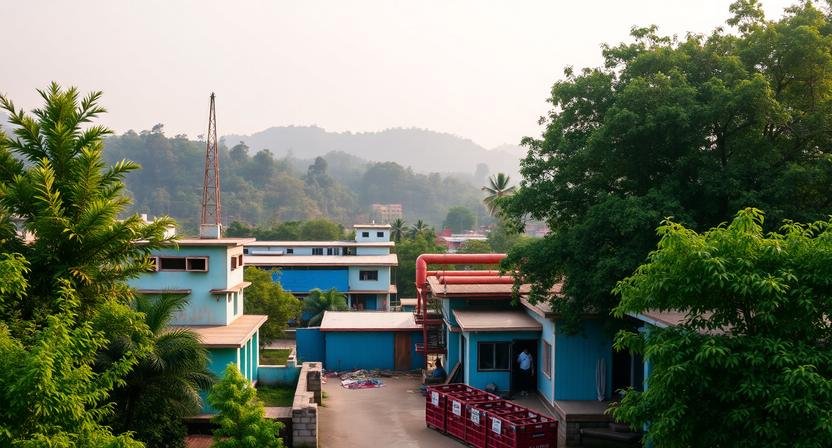
The recent discussions around the Asian Paints plant shutdown in Baddi have raised important questions for business leaders, local workers, suppliers, and regional economic planners. Although the actual shutdown of operations at the Baddi facility happened over a decade ago, its implications continue to resonate in industry conversations.
Understanding what led to that closure, how it impacted the industrial hub of Baddi‑Nalagarh, and what lessons it holds for local sectors today is crucial for stakeholders across manufacturing, logistics, and regional development.
This article offers a comprehensive exploration of the shutdown event and its relevance in 2026, unpacking how such strategic shifts by major corporates influence local industries, employment, business confidence, and investment trends. The goal is to provide clarity for readers who are both new to the topic and those with deeper interest in industrial geography, corporate strategy, and regional economic resilience.
Read Also: BBN Industrial Growth Report: Jobs, Output, and Future Projections
What Happened at the Asian Paints Plant in Baddi?
The Baddi Facility: Background
Asian Paints, India’s largest paint manufacturer and a leading player in decorative and industrial coatings, historically operated several manufacturing units across the country. One of its specialized facilities was the powder coatings plant located in Baddi, Himachal Pradesh. Powder coatings are a type of dry coating used extensively in industrial applications — from automotive parts to appliances — and represent a growth segment due to environmental advantages and performance benefits.
Despite its strategic importance, the Baddi plant faced a sustained decline in processing volumes over time. In a regulatory disclosure during late 2013, Asian Paints Industrial Coatings Ltd (APICL), a wholly‑owned subsidiary of Asian Paints, announced the closure of the power coating operations at the Baddi facility effective November 25, 2013. The official reason cited was a significant decline in business volumes for this segment over the preceding two years, making continued operations at Baddi unsustainable. The company noted that capacity at its Sarigam facility in Gujarat was sufficient to meet current and projected demand for powder coatings, rendering the Baddi operations redundant.
Strategic Realignment Versus Permanent Closure
It is important to distinguish between a temporary shutdown for operational reasons and a strategic closure. In this case, the announcement did not suggest a temporary maintenance pause but a full cessation of operations at the Baddi powder coatings line due to weak volumes. This reflects a strategic reallocation of manufacturing resources rather than broader challenges at Asian Paints’ overall business.
Immediate Local Impacts of the Plant Shutdown
Employment and Workforce Displacement
One of the most direct and visible impacts of the shutdown was on employment. Industrial plants in Baddi, particularly those operated by large corporations like Asian Paints, play a significant role in local job creation. Closure of manufacturing lines often results in layoffs or redeployment, affecting both skilled and semi‑skilled workers.
For employees at the Baddi facility, the shutdown meant either reassignment to other locations (where feasible) or loss of employment. Even with corporate support programs, such disruptions can impose financial strain on workers and families, particularly when alternative opportunities are limited within the same locality.
Supply Chain and Ancillary Businesses
Factories like the Asian Paints plant are nodes in larger supply chains. Local suppliers of raw materials, packaging, logistics, and maintenance services depend on consistent demand from such facilities. When a plant shuts down, even if part of a larger corporate network, ancillary businesses can experience reduced orders and revenue pressures.
This can trigger a cascade of adjustments where small suppliers must either pivot to different sectors or face shrinkage. Regional service providers — transport operators, contract labor firms, local vendors — also feel the ripple effects.
Confidence and Investment Sentiment
Beyond direct business impacts, a plant shutdown affects investor and corporate sentiment about a region. Baddi, located in the Solan district of Himachal Pradesh, is part of one of the state’s key industrial belts along with Barotiwala and Nalagarh. While this region boasts a diversified industrial base including pharmaceuticals, consumer goods, and engineering products, closure of a facility operated by a major brand can influence perceptions about the future of manufacturing in the zone.
Corporate leaders and prospective investors monitor patterns of expansion and contraction when making decisions about new facilities. A shutdown — even for segment‑specific reasons — can lead to questions about long‑term growth potential, infrastructure adequacy, and workforce availability.
Broader Context: Baddi as an Industrial Hub
Structural Strengths of the Baddi Area
Baddi and surrounding towns are widely recognized as one of Asia’s largest pharmaceutical and industrial clusters. This concentration of manufacturing activity is supported by:
- Proximity to major consumer markets in North India.
- Regulatory incentives that have historically attracted businesses.
- A growing workforce with experience across sectors.
- Logistic connectivity facilitating movement of goods.
The cluster effect in Baddi has enabled knowledge sharing, supplier networks, and shared infrastructure that benefit companies of all sizes.
Ongoing Challenges for Industry in the Region
However, manufacturing in Baddi has not been without issues. Connectivity challenges, including road infrastructure and occasional disruptions, have periodically strained operations for many firms. There have been reports of bridge collapses and transport bottlenecks that impact raw material inflows and finished goods dispatch.
Additionally, regional power constraints — frequent interruptions and inadequate capacity — pose operational risks and costs for energy‑intensive industries. These structural constraints suggest that while the region holds competitive strengths, strategic risk factors remain for manufacturing investors.
Comparative Perspective: Asian Paints’ Manufacturing Strategy
Consolidation and Optimization
The Baddi plant shutdown must also be viewed in the context of Asian Paints’ wider manufacturing strategy. Corporates routinely assess plant performance, logistics costs, economies of scale, and market demand to decide where to allocate production. In the case of powder coatings, the company determined that the existing capacity at its Sarigam facility could meet demand without the need to maintain operations at Baddi.
Such optimization allows firms to reduce redundant capacity, enhance profitability, and invest in core growth areas without the drag of underutilized plants.
Expansion Elsewhere
Interestingly, Asian Paints has continued investing in other manufacturing projects. A recent development includes commissioning a new powder coatings facility at Baddi, illustrating the company’s evolving focus on high‑growth industrial segments and updated capacity designs to serve market needs.
This underlines the fact that shutdowns can be part of broader portfolio realignment and capacity upgrading rather than a retreat from a region entirely.
National and Global Trends
Asian Paints’ strategic decisions align with industry trends where global and local players pursue capacity rationalization, technology upgrades, and environmentally compliant manufacturing lines. With sustainability priorities rising and demand for high‑performance coatings growing across auto ancillaries, appliances, and infrastructure categories, paint companies are increasingly investing in advanced facilities while retiring older, less competitive ones.
Long‑Term Implications for Local Industry
Attraction of New Investment
Plant closures can create space for new investments and diversification. Industrial land and infrastructure previously tied up by single‑use facilities become available for repurposing. For Baddi, this could invite interest from companies in emerging sectors like specialty chemicals, renewable energy components, or precision engineering.
Regional policymakers and industrial development boards can leverage such transitions to market the area for future investment, highlighting existing talent pools and improving core infrastructure to compete more effectively with other hubs.
Skill Development and Workforce Mobility
For the local workforce, the shutdown highlights the need for continuous skill development. As manufacturing technologies evolve and demand shifts toward higher value‑added production, workers must adapt through training in areas like digital manufacturing, quality systems, and safety compliance.
Collaboration between industry players, vocational institutions, and government agencies can promote upskilling initiatives that bolster long‑term employability and reduce vulnerability from sector‑specific downturns.
Supply Chain Resilience
The shutdown reinforces the importance of building supply chain resilience at the regional level. Companies operating in Baddi and similar clusters may invest in multi‑tier supplier development, logistics redundancy planning, and collaborative risk mitigation strategies to withstand operational changes from anchor tenants.
Such resilience measures help smaller firms better absorb shocks from large corporate decisions.
Lessons for Regional Planners and Industry Leaders
Strategic Diversification
One clear lesson from the Asian Paints plant shutdown is the value of diversification within industrial clusters. A region heavily reliant on a specific industry or major corporate presence can be vulnerable when that business alters strategy. Encouraging a mix of sectors — pharmaceuticals, specialty chemicals, consumer goods, and advanced manufacturing — fosters economic resilience.
Infrastructure Investment
Infrastructure bottlenecks, whether in power supply, road connectivity, or logistics nodes, can amplify the impact of corporate shifts. Continuous investment in transport corridors, utility capacity, and digital infrastructure is essential to keep industrial zones competitive.
Public‑Private Collaboration
The event underscores the need for robust public‑private collaboration. Governments can work with corporates and industry associations to foresee emerging trends, support workforce development, and co‑fund critical infrastructure projects that benefit multiple stakeholders.
Conclusion
The Asian Paints plant shutdown in Baddi is more than a story of a single factory closing operations; it represents the dynamic interplay between corporate strategy, regional industrial ecosystems, and economic resilience. While the shutdown decision was driven by specific business conditions within the powder coatings segment, its broader implications for workers, suppliers, local confidence, and regional competitiveness are highly instructive.